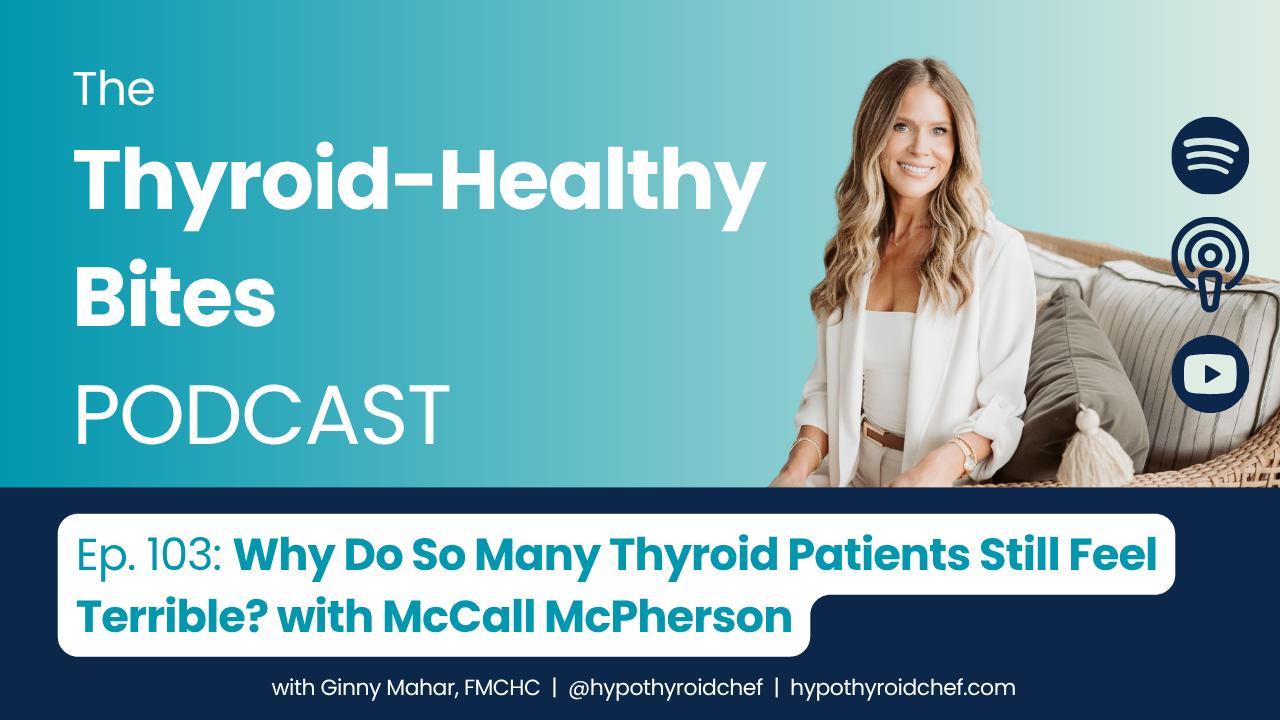
Why Do So Many Thyroid Patients Still Feel Terrible? with McCall McPherson
Your thyroid labs are “normal”… so why do you still feel exhausted, foggy, frustrated with your weight, or just not like yourself?
It’s one of the most common frustrations I hear from the thyroid community. You’ve gotten the diagnosis. You’re taking medication. Your doctor says your labs look fine. And yet… you still don’t feel well.
So what’s going on?
In this episode of Thyroid-Healthy Bites, I’m joined by thyroid and hormone health expert McCall McPherson, PA-C, founder of Modern Thyroid Clinic, to explore why so many thyroid patients continue to struggle even after they’ve been diagnosed and treated.
McCall has worked with (and gathered data from) thousands of thyroid patients who have felt dismissed, unheard, or stuck despite being told that everything looks “normal.” In our conversation, we dig into common gaps in thyroid testing and treatment, and why getting better requires looking beyond a single lab marker or one-size-fits-all medication approach.
We talk about TSH testing versus full thyroid panels, “normal” versus optimal lab ranges, Hashimoto’s and thyroid antibodies, the full menu of medication options, stubborn thyroid-related weight issues, and how to tell when symptoms may be coming from something other than your thyroid.
We also get into a topic I know many Thyroid Thrivers are curious about right now: GLP-1 medications and where they may (or may not) fit into the picture for thyroid patients.
If your labs look “normal” but you still feel lousy, this episode will help you understand some of the reasons why, and what you can do about it.
Scroll down to listen on your favorite podcast platform, or watch the full interview on YouTube.
Disclaimer: This information is for educational and inspirational purposes only. Always consult with your doctor or other qualified healthcare providers before making changes to your diet, health care, medications, or exercise regimen.

Podcast Links:
- Listen on the Podcast Page
- Listen / Subscribe on Apple Podcasts
- Listen / Follow on Spotify
- Watch / Subscribe on YouTube
What You’ll Learn in This Episode
One of the hardest parts of living with hypothyroidism or Hashimoto’s is figuring out what your symptoms are actually telling you.
Fatigue, brain fog, weight changes, low mood, digestive issues, and other common complaints can absolutely be associated with thyroid dysfunction... but they can also overlap with things like perimenopause, gut health issues, stress, sleep disruption, nutrient deficiencies, and other health concerns.
That’s one reason thyroid care can get complicated fast.
In this episode, McCall and I discuss:
- Why you may still have symptoms even when your thyroid labs are “normal”
- Why TSH alone may not always provide the full picture
- Which thyroid labs may be useful to discuss with your provider
- The difference between “normal” and optimal thyroid lab ranges
- Why thyroid antibody testing matters for Hashimoto’s
- Why some patients do well on levothyroxine while others may need a different approach
- How to think about whether symptoms are really coming from your thyroid, or something else
- The role of nutrition, sleep, stress, and lifestyle in thyroid health
- Why weight loss can be especially challenging for people with thyroid disease
- What thyroid patients should know about GLP-1 medications
- How to advocate for yourself when you feel like your treatment isn’t working
- What to look for in a thyroid specialist
When “Normal” Doesn’t Mean You Feel Well
There’s an important distinction between having "normal" lab results and actually feeling well.
That doesn’t mean lab ranges are meaningless, or that every lingering symptom must be caused by the thyroid. In fact, one of the themes we return to in this conversation is the importance of considering the whole clinical picture rather than assuming every symptom has a single explanation.
Thyroid hormones affect many systems throughout the body, which can make it difficult to tease apart what’s truly thyroid-related and what may be coming from another source.
That’s why a thoughtful evaluation may include not only thyroid labs and medication response, but also questions about sleep, nutrition, stress, hormones, metabolic health, gut health, and other factors that can influence how you feel.
Why Thyroid Treatment Isn’t One-Size-Fits-All
Medication is another area where thyroid patients can quickly run into conflicting opinions.
Some people feel great on levothyroxine. Others continue to struggle and may benefit from discussing different medication strategies with a knowledgeable provider. McCall and I talk about the roles of T4 and T3, why individual response matters, and why thyroid treatment often requires more nuance than simply increasing a dose and waiting to see what happens.
At the same time, medication is only one piece of the puzzle.
Nutrition, sleep, stress management, movement, and other lifestyle factors can all support overall health, but they aren’t substitutes for appropriate thyroid treatment when thyroid hormone replacement is needed. The goal is not to find one magical intervention. It’s to build a more complete, individualized approach.
What About Weight Loss Struggles and GLP-1s?
We also spend time discussing a topic that comes up constantly in the thyroid community: weight loss.
Many people with hypothyroidism know firsthand how frustrating it can be to feel like they’re doing everything “right” and still struggling to lose weight.
McCall shares her perspective on factors that can complicate weight management for thyroid patients, along with her thoughts on the growing use of GLP-1 medications.
Rather than treating GLP-1s as either miracle drugs or something thyroid patients should automatically avoid, our conversation looks at them as one potential tool that requires individualized medical decision-making, realistic expectations, and an understanding of both potential benefits and risks.

About McCall McPherson
McCall McPherson, PA-C, is a thyroid and hormone health expert, TEDx speaker, and founder of Modern Thyroid Clinic.
After her own experience with thyroid dysfunction, McCall built a practice focused on helping patients who continue to struggle despite being told their thyroid labs are “normal.” She and her team work with thyroid patients using a personalized approach to testing, medication management, and whole-person care.
Connect with McCall:
- Modern Thyroid Clinic
- FREE Thyroid Lab Guide
- Pre-Order McCall’s book, Take Back Your Thyroid
- Follow McCall on Instagram
Final Thoughts
If there’s one thing I hope you take away from this conversation, it’s that if you're not feeling well, or struggling to get the help and testing you need, there are options out there. There's a lot more to thriving with hypothyroidism than what most patients are offered or taught, and the right provider is one who appreciates that there is no one-size-fits-all approach.
Good thyroid care requires context. That means looking at your symptoms, your labs, your medication response, your health history, and the bigger picture of what else may be going on in your body.
Most importantly, you deserve to be taken seriously when you don’t feel well, even if your TSH is in the "normal" range.
McCall is a true thyroid advocate and Thyroid Thriver. I hope this conversation with her leaves you feeling more informed, more empowered to ask questions, and better equipped to advocate for the care you need.
Cheering you on,

P.S. You might also enjoy these episodes of Thyroid-Healthy Bites:
- What Do Your Thyroid Test Results Mean with Mary Shomon
- The Thyroid Treatment Debacle with Drs. Eric Balcavage and Kelly Halderman
- The 8 Daily Rituals of Thyroid-Healthy Living
Subscribe to my free newsletter for fresh recipes & lifestyle tips, delivered weekly, and receive a free gift!
By submitting this form, you agree to receive ongoing updates from Hypothyroid Chef